This is the final part of our four-part series for UK families. The full series is at news.atozofcyber.co.uk
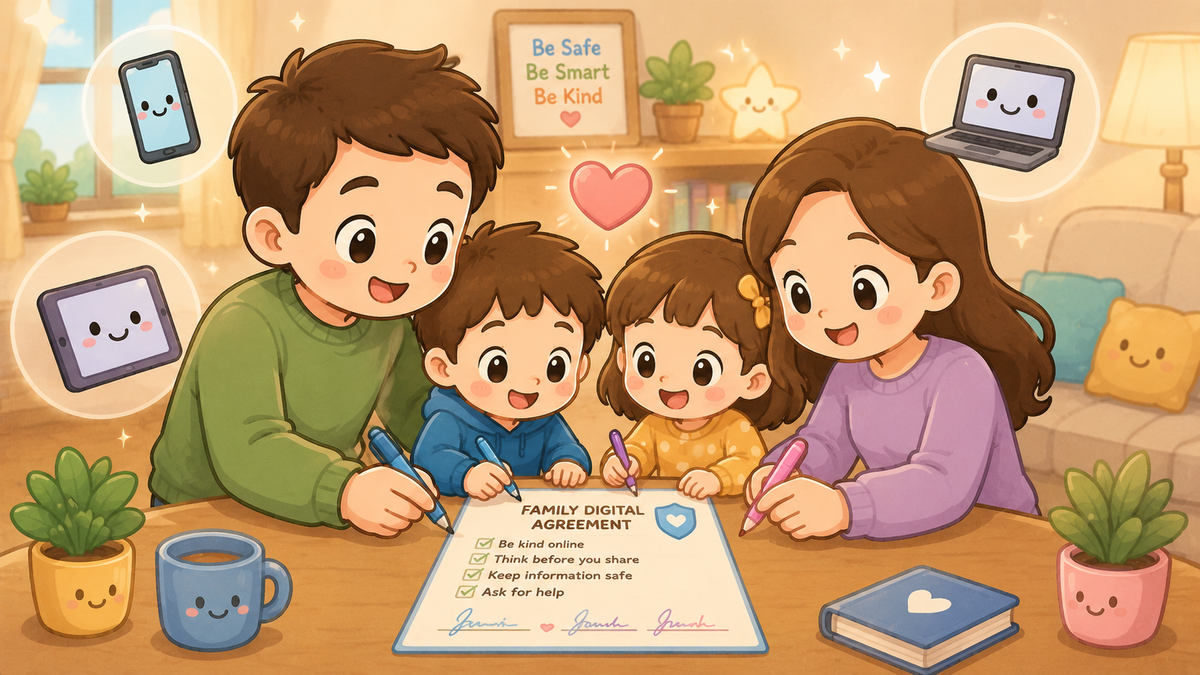
Over the past three weeks we have covered your child's first phone, gaming and online chat, and what to do when something goes wrong. This final article pulls everything together into something practical you can use at home — a family digital agreement.
This is not a legal document. It is not a list of rules to be handed down from parent to child. It is a conversation made visible — a shared understanding of how your family uses technology, what the boundaries are, and what happens when something goes wrong. The research on what actually works is consistent: children who have been involved in creating their own digital boundaries are significantly more likely to stick to them than children who have had rules imposed on them.
Why a written agreement works better than rules
Rules are things that get broken and forgotten. An agreement is something that was discussed, shaped, and signed. The difference is ownership.
A family digital agreement works best when it is genuinely co-created — when children have contributed to what goes in it, when the reasoning behind each element has been explained, and when parents have been honest about their own digital habits too. A parent who insists on no phones at the dinner table while checking their own phone at the dinner table has undermined the agreement before it starts.
It also works best when it is revisited. A set of boundaries appropriate for a ten-year-old is not appropriate for a fourteen-year-old. Building in a regular review — every six months, or at the start of each school year — signals that the agreement is about growing trust, not permanent restriction.
What a good family digital agreement covers
There is no single template that works for every family. But the following areas cover the most important ground.
Devices and times. Where are devices used? Are phones allowed in bedrooms overnight? Are there phone-free times — dinner, family time, the hour before bed? The evidence on sleep and screen time is clear: blue light from screens suppresses melatonin, and many children who struggle with sleep have devices in their bedrooms. This does not have to be framed as a punishment — it can be framed as something the whole family does, including parents.
What can be downloaded and what cannot. Who approves new apps and games? Is there a minimum age rating for games? Are in-app purchases allowed, and if so up to what value without asking? Making this explicit prevents arguments later and removes the awkwardness of individual negotiations over each new request.
Personal information. What information is your child allowed to share online? Their real name? Their school? Their location? A sensible default for younger children is: no real name, no school name, no location, no photographs that identify where you live or go to school. For older children, the conversation shifts to judgment — when and why is it appropriate to share more, and with whom.
What to do when something feels wrong. This is the most important section, and the one most often left out. Write it down: if something online upsets you, frightens you, or confuses you, tell a parent or trusted adult. You will not be in trouble. You will not lose your device. We will deal with it together.
How the agreement is reviewed. Set a date. Put it in the calendar. A family digital agreement that is never revisited becomes a historical document rather than a living one.
A note on trust and monitoring
The question of how much to monitor your child's online activity is one of the most contested in modern parenting. There is no universal right answer, but the research points in a consistent direction: covert surveillance — secretly reading messages, installing hidden tracking software without your child's knowledge — tends to damage trust when discovered, and it will be discovered. Transparent monitoring — where your child knows you can see what they are doing, and understands why — is more effective and less harmful to the relationship.
The goal of a family digital agreement is not to eliminate risk. It is to build the judgment and trust that allows risk to be managed over time. A ten-year-old with strict controls and no conversations is less prepared for digital independence at sixteen than a ten-year-old with lighter controls and rich, ongoing conversations about what they encounter online.
The transition to independence should be gradual and earned. Each time a boundary is respected, the case for extending trust is stronger. Each time a problem is disclosed honestly, the communication channel is reinforced. The agreement is the scaffold. The relationship is the structure.
A simple template to start with
You do not need to use this verbatim — adapt it to your family, your children's ages, and your own values. The point is to have the conversation, not to produce a perfect document.
Our family digital agreement:
We agree that devices are used in shared spaces in the evenings, and that phones are charged outside bedrooms overnight.
We agree that new apps and games need a parent to approve them before they are downloaded.
We agree that we do not share our real surname, our school name, our address, or our location with people we have only met online.
We agree that in-app purchases over [£X] need a parent's permission first.
We agree that if anything online upsets, frightens, or confuses any of us, we tell someone in the family. Nobody gets in trouble for coming forward.
We agree to review this agreement together at the start of each school year.
Signed: _______________________ Date: _______________________
The bigger picture
The UK government's consultation on children's online experiences closed on 26 May 2026. The government has signalled it intends to act quickly on the findings — further strengthening the Online Safety Act, increasing platform accountability, and improving support for families. Those changes will take time to work through the legislative process.
In the meantime, the most effective protection for your child is not waiting for platforms to improve or for the law to catch up. It is the quality of the conversations happening in your home.
Ofcom's own research has found that children who feel they can talk to a trusted adult about what they encounter online are better equipped to handle it — not because the risks are smaller, but because they are not facing them alone.
The phone is not the problem and it is not the solution. The conversation is both.
What does this mean for me?
Start the conversation this week. You do not need a perfect template — you need a willingness to sit down and talk about how your family uses technology and what the shared expectations are.
Involve your children in writing it. Their investment in the agreement is what makes it work.
Apply it to yourself too. A family digital agreement that only binds the children is not an agreement. It is a set of rules.
Review it. Put a date in the calendar right now — the start of the next school year, or six months from today.
Keep the conversation going. The agreement is a starting point, not an ending. The most important conversations will happen in the car, at the dinner table, and in the moments when your child says "can I ask you something?" — not in the formal review.
🧠 The Human Factor
| Technology involved | The full range of devices, platforms, and apps that families use — managed through shared expectations rather than technical controls alone |
| Root cause | Most digital safety failures in families happen not because of technology but because of absent or one-sided conversations — rules without reasoning, controls without trust |
| What was at risk | A child's safety, wellbeing, and digital judgment — and the parent-child relationship that is the most powerful protective factor available |
| Prevention | A co-created, regularly reviewed family digital agreement; honest conversations that include parents as well as children; gradual, trust-based extension of digital independence |
Useful resources
- Internet Matters: family agreement templates by age — internetmatters.org
- UK Safer Internet Centre — saferinternet.org.uk
- NSPCC: Net Aware (guide to apps and platforms) — net-aware.org.uk
- Childline — childline.org.uk or 0800 1111
- Ofcom: children and media use research — ofcom.org.uk
This concludes the Your Digital Family series. If you have found it useful, please share it with other parents. Future series will cover scams, AI in schools, and online privacy for the whole family.