Part 2 of our plain-English series for UK families. Part 1 — Your child's first phone — is at news.atozofcyber.co.uk
Ask most parents what their child does online and the answer is usually something like "plays games, watches videos, chats with friends." All of that is probably true. What is also true — and what most parents do not fully appreciate — is that those three activities increasingly happen in the same place, at the same time, with the same people. And some of those people are not who they say they are.
This article is not about panicking. The vast majority of children who play online games and use chat features do so safely. It is about understanding what those environments actually look like, so you can have informed conversations rather than vague warnings.
What gaming actually looks like now
Gaming is no longer primarily a solitary activity. The most popular games played by children in the UK — Roblox, Fortnite, Minecraft, FIFA, Call of Duty — are social environments. They have built-in voice chat, text chat, friend systems, private messaging, and in some cases the ability to follow or be followed by strangers.
Roblox alone has 111 million daily active users. Most of its players are under 18. Many are significantly younger. The platform is not simply a game — it is a creation platform where players build and share their own game worlds. Some of those worlds, created by other players rather than Roblox itself, contain content that is entirely inappropriate for the children who find their way into them.
In March 2026, Ofcom formally wrote to Roblox — alongside Facebook, Instagram, Snapchat, TikTok, and YouTube — setting out four specific demands: better age enforcement, stronger anti-grooming controls, safer algorithmic recommendations, and proper safety testing before new features are launched. The deadline for those platforms to report back was 30 April 2026. That Ofcom felt it necessary to send this letter at all tells you something about the current state of protection on these platforms.
The pattern worth understanding: the move
There is a pattern documented by child protection organisations, law enforcement, and researchers that parents should understand. It is sometimes called the move.
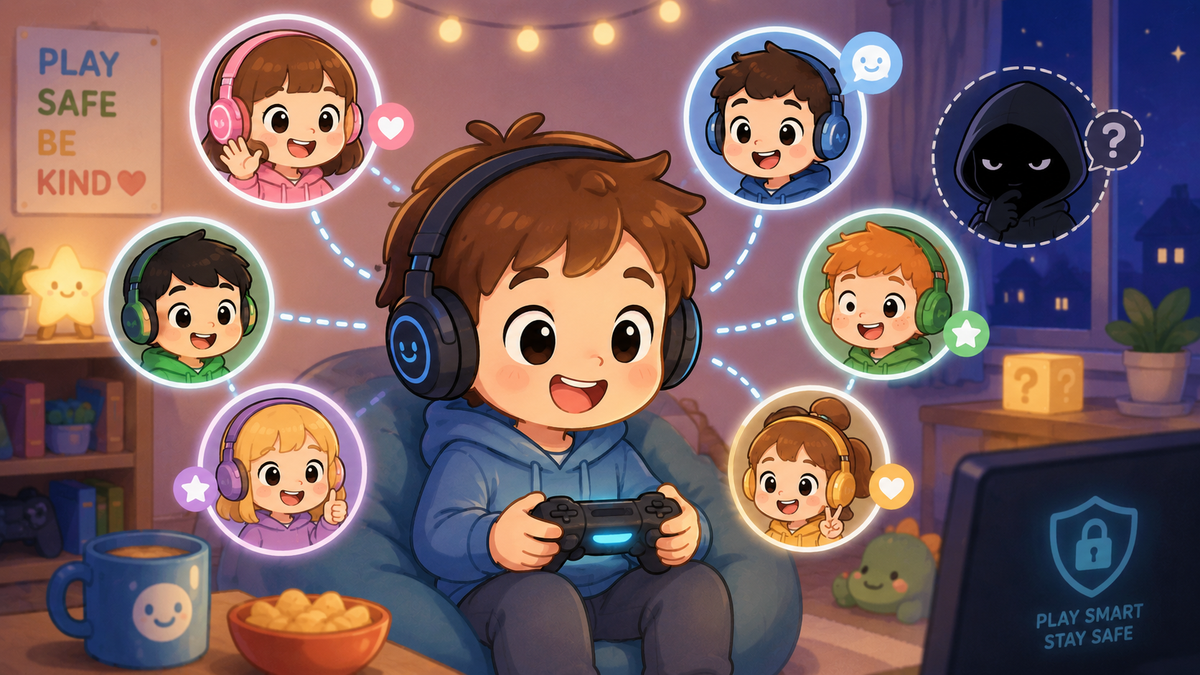
A child is playing a game — Roblox is the most commonly cited example, but it happens across platforms. Another player approaches them, claims to be around the same age, and begins building a friendship over days or weeks. The conversation is friendly, fun, and entirely within the game. Then, at some point, the other player suggests moving the conversation somewhere more private — Discord, Snapchat, WhatsApp, or private messages. The reason given is usually something like "it's easier to talk there" or "I don't want randoms reading our chat."
Once the conversation moves off the main platform — which has at least some moderation — the nature of it can change. This is where grooming tends to escalate: requests for images, personal information, eventually meetings.
This is not a rare edge case. It is a documented, recurring pattern across multiple platforms and multiple countries. The UNICEF Innocenti research centre described gaming platforms as "mixed-age spaces" where adults and children interact freely — and noted that predators exploit the agency children feel in gaming environments, where they often direct and organise other players, to build trust and establish relationships.
The most protective thing a child can know is this: when someone you only know from a game asks to move the conversation somewhere private, that is a moment to tell a trusted adult.
What children spend in games
This deserves its own conversation, because it is affecting families across the income spectrum and it is not always recognised for what it is.
The most popular children's games are free to download. They make their money through in-game purchases — cosmetic items, passes, currency, loot boxes. A University of Sydney study in 2025 found that children as young as seven, given a real debit card to use within Roblox, made purchases almost immediately — and some described the monetisation systems as "scams" or "cash grabs" without fully understanding what they had spent.
These systems are specifically designed by professional psychologists and game designers to be compelling. They use variable reward — the same mechanism as a slot machine — to make spending feel exciting. They obscure the real cost by using in-game currency rather than pounds. And they are targeted at children who have not yet developed the full capacity to understand long-term consequences of spending.
This is not a reason to ban games. It is a reason to have a clear, practical conversation about real money and in-game purchases before your child starts playing, and to check payment settings on every device and platform.
Practical things to do right now
Review the chat settings on every game your child plays. Most games allow you to restrict chat to friends only, turn off voice chat, or disable chat entirely for younger players. These settings are not always switched on by default. In Roblox, for example, the default chat settings depend on the age given at registration — which may or may not be accurate.
Know which games your child plays and spend twenty minutes playing them yourself. Not to police them — to understand what the environment is actually like. The social dynamics of Roblox or Fortnite are very different from what the name on the box suggests. Fifteen minutes of your time is worth more than any content filter.
Remove payment details from gaming platforms, or set spending limits. Apple, Google, PlayStation, and Xbox all allow you to set spending limits, require parental approval for purchases, or remove saved payment information entirely. Do this before it becomes an issue.
Teach the move. Tell your child explicitly: if anyone you only know from a game asks to move the conversation somewhere private, come and tell me. You are not in trouble. I just want to know.
What about age ratings?
Games, like films, carry age ratings from PEGI — the Pan European Game Information system. A PEGI 18 game is rated for adults. A PEGI 7 game is rated for children aged seven and over.
Most parents are aware that PEGI ratings exist. Fewer pay close attention to them. And many children play games rated well above their age — sometimes with parental knowledge, sometimes without.
PEGI ratings are not infallible guides to what is right for your individual child, but they exist for reasons worth understanding. A PEGI 18 game may contain graphic violence, explicit content, or online environments with no content moderation. The rating is a starting point for a conversation, not a final answer.
What does this mean for me?
Check the chat settings on every game your child plays this week — not just on their phone but on consoles, tablets, and computers.
Remove or limit payment details on gaming platforms before in-app spending becomes an issue.
Teach your child about the move. Make it a specific, named thing they know to watch for — not a vague warning about strangers, but a clear description of a specific pattern.
Play the games yourself, even briefly. Understanding the environment your child spends time in is the most underrated thing a parent can do.
Have the money conversation before they start playing, not after the first unexpected charge appears.
🧠 The Human Factor
| Technology involved | Online multiplayer gaming platforms (Roblox, Fortnite, Minecraft and others), in-game chat systems, private messaging, and in-game purchase mechanisms |
| Root cause | Gaming platforms are social environments that blur the line between play and communication — and the same features that make them fun also make them accessible to adults with harmful intentions and to sophisticated commercial monetisation systems |
| What was at risk | Children's personal safety, privacy, and financial wellbeing — and the trust they place in online relationships that may not be what they appear |
| Prevention | Review and restrict chat settings; remove payment details; teach children the specific pattern of "the move"; play the games yourself to understand the environment |
Useful resources
- Internet Watch Foundation — iwf.org.uk
- CEOP (Child Exploitation and Online Protection) — ceop.police.uk
- Report abuse or grooming: thinkuknow.co.uk
- NSPCC: Keeping children safe online — nspcc.org.uk/online-safety
- Childline (for children) — childline.org.uk or 0800 1111
Next in the series: When something goes wrong — how to talk to your child about online incidents without making it worse.