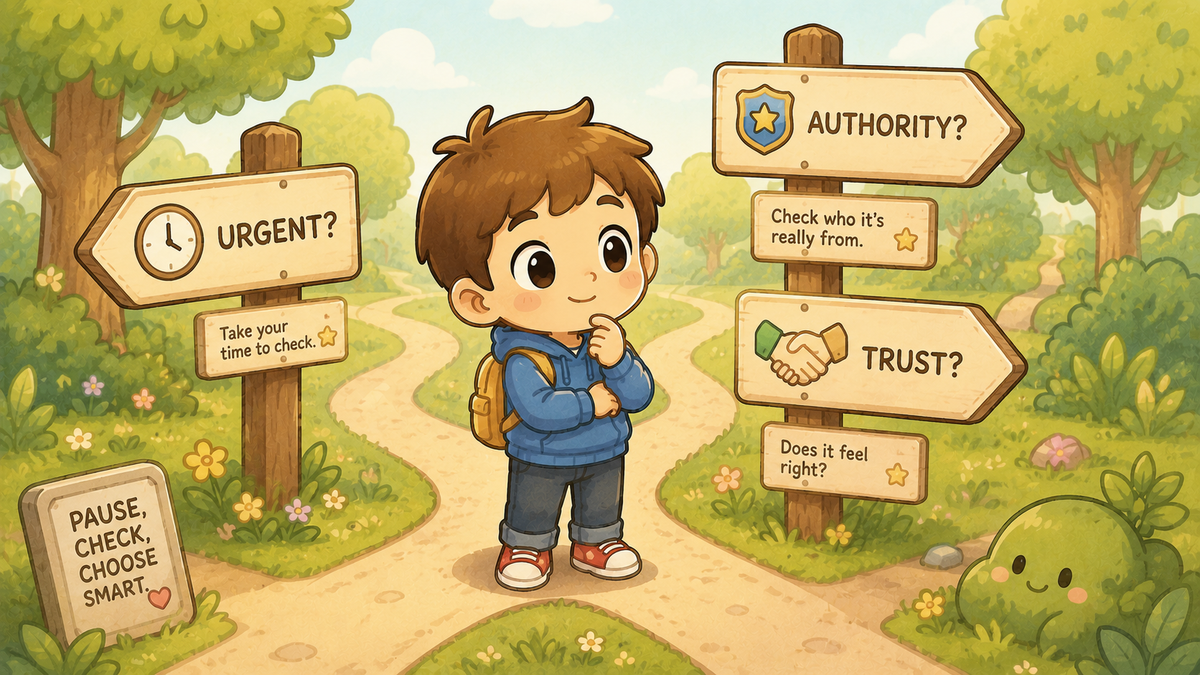
This is the first in a new four-part series about scams, fraud, and how to protect yourself. Plain English, no judgement, practical advice for everyone.
Every year, millions of people in the UK are targeted by scams. Hundreds of thousands lose money. In 2025, UK fraud losses reached £3.4 billion — roughly £280,000 every single day to romance fraud alone. Investment scams cost individual victims an average of £40,000 each.
The people who lose that money are not foolish. They are not naive. They are not a different type of person from you. They are teachers, engineers, retired headteachers, NHS workers, and university students. They are people who have spent their whole lives being careful, sensible, and thoughtful.
Understanding why scams work is the most important thing you can do to protect yourself. Because the answer is not about intelligence. It is about psychology — and the specific, predictable ways that all human brains work under certain conditions.
So how do scams actually work?
At their core, every scam — regardless of how sophisticated or how simple — does the same thing. It creates a set of conditions in which your brain makes a decision that, in hindsight, you would not have made.
Scammers are, in a meaningful sense, applied psychologists. Not because they have studied psychology formally, but because the most effective scam techniques have been refined over decades of trial and error into a set of approaches that reliably exploit predictable human responses. Understanding those approaches is the first step to recognising them.
Urgency. The single most powerful tool in a scammer's kit is time pressure. "Your account will be closed in 24 hours." "This offer expires tonight." "You must act now to avoid arrest." Urgency works because the human brain, under time pressure, switches from careful deliberate thinking to fast instinctive thinking. Fast thinking is efficient and usually right. But it is also the mode in which we are most susceptible to shortcuts and errors. A decision that takes five seconds is far more likely to be the wrong one than a decision that takes five minutes.
Authority. We are wired from childhood to respond to authority. A message that appears to come from HMRC, your bank, the police, or the NHS carries an automatic weight that a message from a stranger does not. Scammers exploit this by impersonating trusted institutions, using their logos, their language, and in many cases their actual name in the sender field of an email or text. The authority is borrowed, but the psychological response it triggers is real.
Familiarity. If someone knows your name, your bank, your postcode, or the last four digits of your card number, they feel less like a stranger. They feel like someone who already has a relationship with you. This information is widely available through data breaches and social media — and scammers use it deliberately to lower your guard. Familiarity is not proof of legitimacy.
Reciprocity. If someone does something for you — offers you an exclusive opportunity, gives you helpful information, spends weeks building a warm relationship — you feel a natural pull to reciprocate. This is not a character flaw. It is a prosocial instinct that makes human relationships work. Scammers exploit it by investing time and apparent generosity before making their request.
Social proof. We are influenced by what others appear to be doing. "Thousands of customers have already claimed their refund." "This investment opportunity is already fully subscribed — we saved a spot for you." The implication that other sensible people have already done the thing being asked makes the ask feel safer. It is not.
Optimism bias. Research shows that most people believe they are less likely than average to fall for a scam. This belief — the conviction that it happens to other people, not to us — is itself one of the things that makes us vulnerable. The person who is certain they would never be fooled is not on guard in the way that someone with genuine uncertainty would be.
Why AI is making this harder
Every one of the techniques above has been made significantly more effective by AI tools in the hands of criminals.
Messages that used to be spotted by poor grammar and odd phrasing are now fluent, natural, and sometimes personalised with specific details about the recipient. Voice cloning allows a scammer to produce a convincing audio clip of a family member's voice from three seconds of a social media video. Deepfake video calls allow a criminal to appear on screen as a convincing version of a bank employee. AI allows a single criminal to maintain dozens of fake relationships simultaneously, each one tailored to the emotional triggers of the individual target.
The NCSC flagged a significant rise in AI-assisted credential-harvesting campaigns in early 2026, targeting HMRC, major banks, and NHS digital services. These are not amateur operations. They are professional enterprises with tools, processes, and quality control.
The thing that matters most
Being targeted by a scam is not a reflection of your intelligence, your education, or your character. The research is consistent on this: scam victimisation correlates not with intelligence but with circumstance. People who are going through a difficult period — financial stress, bereavement, loneliness, illness — are more vulnerable, not because they become less intelligent, but because their cognitive resources are already stretched.
The most protective thing is awareness — not anxious vigilance, but a calm, consistent habit of pausing when something asks you to act quickly. That pause is the intervention. It gives your slower, more careful thinking the time to catch up with the situation.
In the next three parts of this series, we will look at the specific scams most commonly targeting people in the UK right now, how romance and investment fraud works in practice, and exactly what to do if you or someone you know has been targeted.
What does this mean for me?
Urgency is the biggest warning sign. Any message that tells you to act now, immediately, or risk losing something should slow you down rather than speed you up. The more urgent the request, the more important it is to pause.
Familiarity is not legitimacy. Someone who knows your name, your bank, or your postcode is not necessarily who they say they are.
Legitimate organisations will always give you time. Your bank, HMRC, and the police will not penalise you for taking five minutes to call them back on a number you already have.
Talk about scams openly. The stigma around being targeted — the embarrassment of almost being fooled, or of having been fooled — is one of the things that keeps people silent and keeps scammers in business. The more openly families, friends, and colleagues talk about what they have seen, the harder scams become to run.
🧠 The Human Factor
| Technology involved | Every channel available — phone calls, texts, emails, social media, dating apps, and increasingly AI-generated voice and video — used to deliver psychologically crafted messages |
| Root cause | Scams do not exploit stupidity. They exploit predictable human psychological responses — urgency, authority, familiarity, and trust — that exist because they are useful in normal life |
| What was at risk | £3.4 billion lost to UK fraud in 2025 alone — but the financial loss is only part of the picture. Research shows scam victims experience significant depression, anxiety, shame, and loss of trust |
| Prevention | Awareness of the specific techniques used; the habit of pausing before acting on any unsolicited request; open conversations about scams that reduce stigma and increase early warning |
Next in the series: The scams targeting you right now — HMRC, parcel delivery, bank impersonation, and the fake safe account.
References and sources
- City of London Police / Report Fraud: UK fraud statistics 2025 — reportfraud.police.uk
- UK Finance: APP fraud reimbursement guidance — ukfinance.org.uk
- National Cyber Security Centre: AI-assisted phishing warning, early 2026 — ncsc.gov.uk
- Which? Psychology of scams research — which.co.uk
- University of Exeter / Office of Fair Trading: The Psychology of Scams — via Stanford Longevity Center
- NIH/PMC: The Mental Health Impacts of Internet Scams (2025)
- Beacon IT: UK Cyber Crime Statistics 2026 — beaconit.co.uk