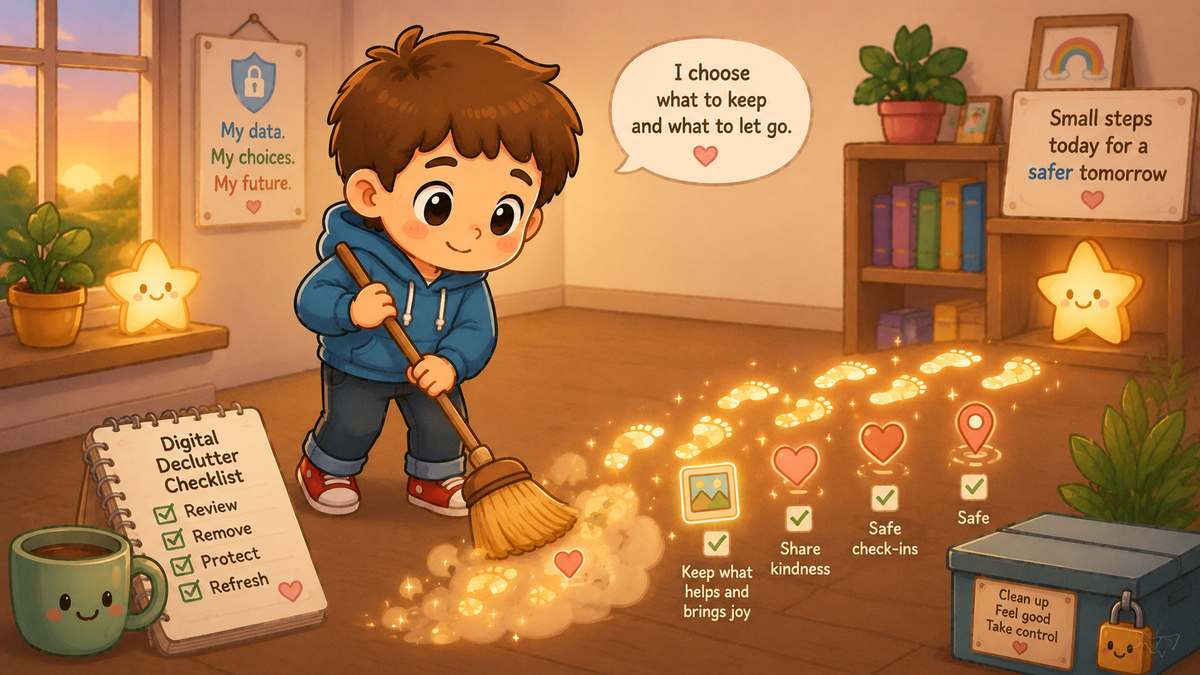
This is the final part of our series on online privacy. The full series is at news.atozofcyber.co.uk
Over the past three weeks we have covered what a digital footprint actually is, what social media platforms collect and how to audit your settings, and how data brokers compile and trade information you never knowingly gave them. This final article brings it together into something you can actually act on — a practical, prioritised plan, not an overwhelming list of everything you theoretically could do.
The goal is not digital invisibility. That is not realistic and, for most people, not even desirable — a complete absence of any online presence can itself look unusual to employers, landlords, or anyone checking up on you for legitimate reasons. The goal is intentional, informed control over what you share and what is collected without your active choice.
The thirty-minute starting point
If you do nothing else from this series, do this. It takes about thirty minutes and addresses the highest-impact items.
Search your own name alongside your town, employer, and any previous addresses. Note what comes up.
Check your most-used social media account from a logged-out view. See what a stranger actually sees.
Turn on two-factor authentication on your email account. Your email is the recovery point for almost every other account you have. If it is compromised, everything connected to it is at risk. The NCSC notes that even if a criminal knows your password, two-factor authentication stops them getting in.
Review location permissions on your phone. Go through your apps and check which ones have access to your location, and whether they need it constantly or only while in use. Most do not need constant access.
Send one combined data request. Pick the single most concerning result from your name search and send one combined Article 15/21/17 request, as covered in Part 3. You do not need to do all of them today — start with one.
The ongoing habits worth building
A six-monthly review. Set a calendar reminder. Repeat the name search, check your social media settings have not reverted after a platform update, and resend any data broker requests where the information has reappeared.
Pause before oversharing. Before posting anything that reveals your location in real time, your children's school, your daily routine, or details about an upcoming holiday while your house will be empty, ask whether this needs to be public, or whether a private message to the people who actually need to know would do the job just as well.
Use separate accounts for separate purposes where it matters. A professional LinkedIn presence and a personal social account serving different functions, with different audiences, is a simple way to reduce how much any single platform or viewer can infer about the whole of your life.
Read the headline terms before joining a new trend or service, particularly anything involving uploading your photograph — a lesson from Part 1 of our AI series earlier this year that applies here too. Two minutes spent checking what a company says it will do with your data is rarely wasted.
Talk to your family about this, especially older relatives and children. The habits in this series are most protective when shared. An elderly parent whose digital footprint is smaller and more deliberately managed is a harder target for the impersonation scams covered in our last series. A child who understands the basics of privacy settings early is better equipped as their online life grows.
What this protects you against, concretely
It is worth being specific about why this matters, beyond a general sense of privacy.
A smaller, more deliberately managed digital footprint makes you a harder target for the phishing and impersonation scams covered extensively in our Don't Get Scammed series — there is simply less personal detail available for a criminal to use to make a fake message convincing. It reduces your exposure to the kind of platform-level data failures the ICO has been actively fining major companies for throughout 2026. It gives you genuine legal leverage — the rights under UK GDPR that we covered in Part 3 are real, enforceable, and free to exercise. And it gives you back a degree of authorship over how you are represented online, rather than leaving that entirely to algorithms, data brokers, and the people who happen to tag you in things.
None of this requires becoming an expert in data protection law or spending hours every week on privacy maintenance. It requires a handful of deliberate habits, repeated periodically, applied with the same routine attention you might give to checking your bank statement or renewing your car insurance.
A final word on proportion
It would be easy to read this series and conclude that the internet is a hostile, surveillance-saturated place that cannot be safely used. That is not the right takeaway, and it is not the one this site intends.
The internet remains an extraordinary tool for connection, information, and convenience. The companies and systems described in this series are not uniformly malicious — most are simply optimising for their own commercial interests, which do not always align neatly with yours. Understanding that distinction is itself useful: this is not a series of villains to fear, but a system of incentives to navigate with open eyes.
The most protective stance is not anxiety. It is informed, periodic attention — the same calm, practical habit of mind that this site has tried to model in every series so far. You do not need to win every battle for privacy to meaningfully reduce your exposure. You need to win the ones that matter most, and to keep winning them periodically, for the rest of the time you spend online.
What does this mean for me?
Do the thirty-minute starting point this week if you have not already worked through the series.
Set a six-monthly reminder to repeat the name search and resend any data broker requests where information has reappeared.
Build the pause-before-posting habit, particularly around real-time location, children's details, and holiday plans.
Talk to your family about it — the protective value compounds when more people in your life adopt the same habits.
Keep this proportionate. The goal is informed control, not anxiety or withdrawal from online life.
🧠 The Human Factor
| Technology involved | The full ecosystem covered across this series — social media platforms, data brokers, search engines, and the apps and devices that passively collect data in the background |
| Root cause | Most digital footprint exposure accumulates gradually, through small individual choices and background collection that nobody consciously decided to allow, rather than through any single dramatic event |
| What was at risk | Identity theft, more convincing scams, exposure to data failures at platform level, and a general loss of control over personal representation online |
| Prevention | A handful of deliberate, periodically repeated habits — name searches, settings audits, two-factor authentication, and the exercise of UK GDPR rights — applied with routine, proportionate attention |
This concludes the Your Digital Footprint series. If you have found it useful, please share it with someone who might benefit — particularly anyone who has never thought about what the internet knows about them.
References and sources
- NCSC: Social media: how to use it safely — ncsc.gov.uk
- ICO: Right to erasure and right to object guidance — ico.org.uk
- Data (Use and Access) Act 2025 — gov.uk
- ICO Children's Code — ico.org.uk