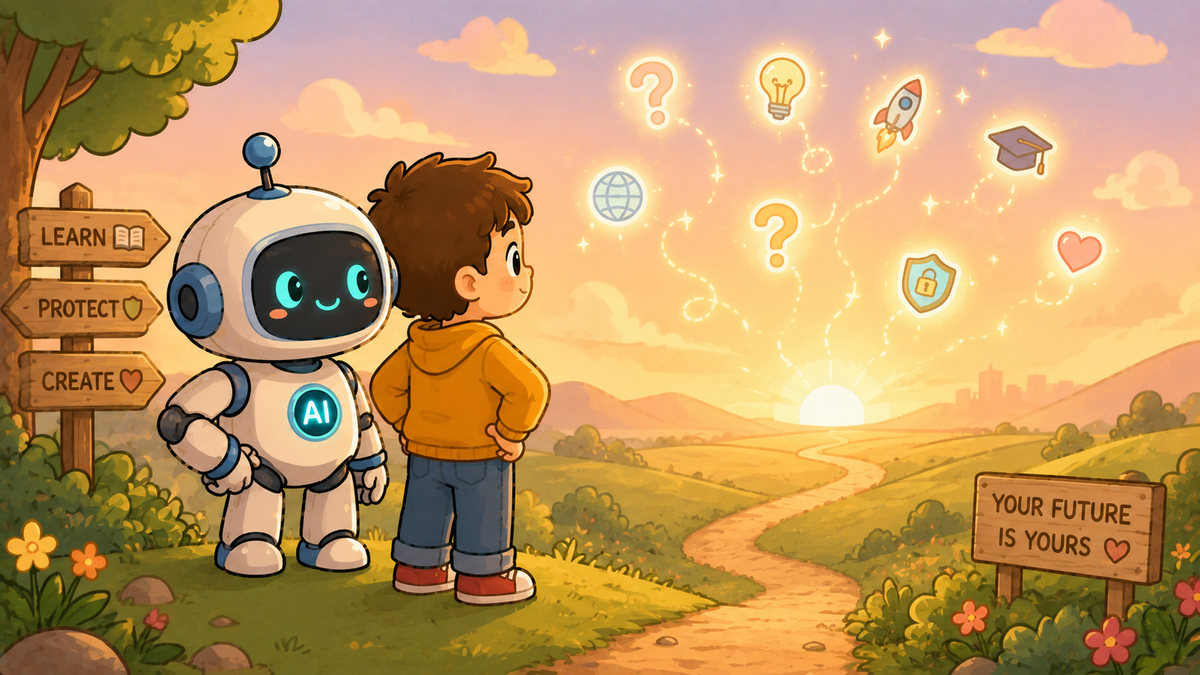
There is a particular kind of anxiety that the AI news cycle produces. Breathless announcements of the next capability, apocalyptic predictions of job displacement, utopian promises of problems solved, a new controversy every fortnight. It is genuinely difficult to maintain a calibrated view of where things are, where they are going, and what it means for you personally.
This final article is an attempt at that calibrated view. What is genuinely coming in the near term, what remains speculative, what you should actually pay attention to, and how to stay informed without the anxiety that constant AI news can generate.
What is genuinely coming
AI agents everywhere, very soon. As covered in the original AI series, agents that take actions rather than just responding are already deployed in workplaces and are arriving rapidly in consumer products. Apple Intelligence, Google's expanded Gemini integration, Microsoft Copilot — all of them are moving toward agentic capabilities that do things on your behalf. Understanding what permissions you are granting, and to what, will become one of the more important digital literacy skills of the next few years.
AI in healthcare, moving from administration to diagnosis. AI tools are already being used in NHS pathology, radiology reading, and clinical decision support. The potential for earlier, more accurate diagnosis in cancer and other conditions is real and is being actively researched and deployed. The governance around how AI-assisted diagnosis is reviewed by human clinicians, and how liability is allocated when AI makes an error, is the active frontier of this work.
AI-generated content becoming the majority of some kinds of content online. Marketing copy, social media posts, product descriptions, certain kinds of journalism — the proportion of this content that is AI-generated or AI-assisted is already significant and growing. The skills covered in Part 2 of the original AI series — how to distinguish AI-generated content from human-created content — are not a niche interest. They will be a broadly relevant competency.
Regulation catching up gradually. The EU AI Act is in force. The UK's own AI regulation is developing. International coordination is slow but progressing. The regulatory framework of 2030 will be significantly clearer than the framework of 2026 — but significant gaps will remain in the interim.
What remains genuinely uncertain
Artificial General Intelligence — AI that can perform any cognitive task a human can, across all domains, with human-level or greater competence — is the thing that generates the most dramatic claims and the most dramatic counter-claims. Some researchers believe it is years away. Others believe it is decades. Others believe it is a category error. The honest position is that nobody knows with confidence, and the claims made by AI companies about their own timelines carry the same self-interested uncertainty as any corporate projection.
Job displacement is real in specific domains and overstated as a general phenomenon. Jobs that involve primarily routine text generation or image production are genuinely affected. Most jobs involve far more complexity, human judgment, relationship management, and contextual adaptation than any current AI system can replicate. The transition will be uneven and will require significant retraining investment — whether that investment will be made at adequate scale and speed is a policy question, not a technology one.
AI consciousness and rights is a debate that generates significant heat and very little light. Current AI systems are pattern-matching engines with no subjective experience, regardless of how fluently they discuss the topic. This is not a settled question among philosophers of mind — but the marketing presentations of AI companies are not the right source for guidance on it.
How to stay calibrated
A few practical principles for consuming AI news without being overwhelmed by it.
Follow the evidence, not the announcement. Every major AI capability comes with a press release. The evidence of what it actually does in real-world deployment, at scale, over time, is significantly more informative. The six months after an announcement tells you far more than the announcement itself.
Notice who is speaking. Someone whose company has just raised £500 million to build AI products has a material interest in the claims they make about AI. Someone who stands to lose work to AI has a material interest in the claims they make in the other direction. Neither is lying. Both are not fully objective.
The NCSC, the ICO, and Ofcom are more reliable than Twitter. The UK's national cyber security authority, data protection regulator, and communications regulator all publish guidance on AI as it affects real people in the UK. It is less exciting than the hot takes. It is more accurate.
Ask the practical question. Not "will AI take over the world" but "how does this specific development affect the specific things I care about?" The specific question almost always has a more useful answer than the general one.
A closing thought on the human factor
This site began as a project about making cybersecurity accessible and human in its framing. Every article, every series, every story has returned to the same observation: technology is a tool. The decisions that matter — to build it, to deploy it, to misuse it, to regulate it, to understand it and defend against it — are human decisions.
AI is not different. It is the largest and fastest-moving technology shift most people alive have experienced, and it will produce significant benefits and significant harms. The proportion of each that we end up with will depend on the human decisions made over the next few years — in boardrooms, in parliament, in classrooms, and in the choices each of us makes about how to use it, what to give it access to, and what we are and are not willing to accept from it.
That framing is, we think, the most useful one. Not fear. Not uncritical enthusiasm. Engaged, informed attention — the same approach that works for every other tool humanity has developed and had to learn to live with well.
What does this mean for me?
Pay attention to permissions as AI agents arrive in your apps and devices. This is the near-term practical frontier.
Build the habit of checking AI output — particularly in professional, medical, legal, or financial contexts — rather than treating it as authoritative.
Stay with reliable sources for AI guidance: NCSC, ICO, Ofcom, and credible journalism rather than company announcements or social media hot takes.
Talk to the people around you. The AI literacy conversation — what it is, what it isn't, what it can and cannot do, what you give it access to and why — is one that families, workplaces, and communities are all having. The more openly it happens, the better the collective outcomes tend to be.
🧠 The Human Factor
| Technology involved | The full spectrum of current and near-future AI development — from consumer agents to healthcare diagnostics to content generation to regulatory frameworks |
| Root cause | AI development is moving faster than public understanding, faster than regulation, and faster than the governance frameworks of the institutions deploying it — creating a period of genuine uncertainty that rewards informed attention over either panic or complacency |
| What was at risk | Everything covered across this series and the one before it — privacy, safety, employment, creative rights, autonomy, and the quality of information in public life |
| Prevention | Informed, engaged attention; reliable sources; the habit of asking practical questions rather than abstract ones; and the ongoing human decisions about how technology is built, deployed, and governed |
Reliable sources for AI guidance
- NCSC: ncsc.gov.uk
- ICO: ico.org.uk
- Ofcom: ofcom.org.uk
- EU AI Act: artificialintelligenceact.eu
- Full AI Series on this site: news.atozofcyber.co.uk
This concludes the AI in the Real World series — and the eight-week content block.