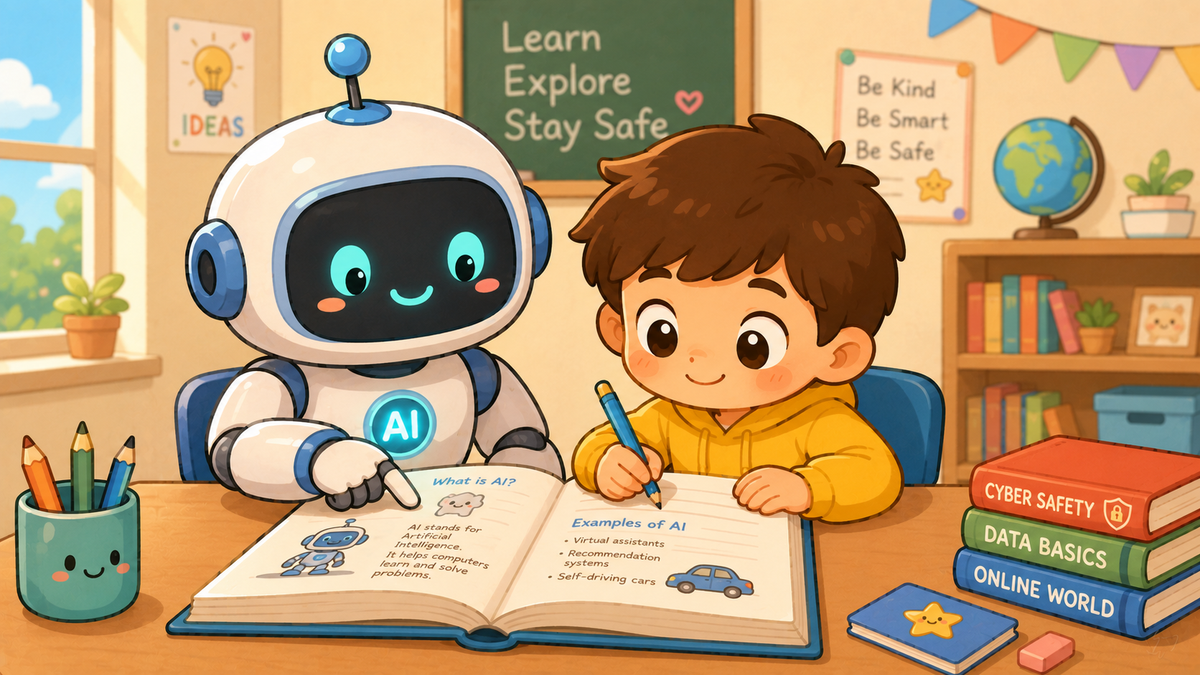
The first series on this site about AI — published in May — covered the basics. What AI is, how it learns, what an agent is, why you should think before uploading your photo to a trending image generator. This new series picks up where that one left off, looking at where AI is landing in the real world right now: in classrooms, in workplaces, in the courts, and in your life in the next few years.
Starting with school, because that is where this generation's relationship with AI is being formed.
What is actually happening in schools
AI tools — particularly ChatGPT, but also Google's Gemini, Microsoft's Copilot, and a growing range of education-specific tools — are being used by children and young people across the UK to help with homework, essays, research, revision, and creative projects.
This is not a rumour or a future concern. It is the present. Ofqual — the exams regulator — has confirmed that AI-generated content has appeared in submitted coursework. Every secondary school teacher in the country is navigating this in some form, and many primary school teachers are not far behind.
The use is not uniform. Some children use AI the way a previous generation used an encyclopedia — to find information and then write about it in their own words. Others use it to generate text they then pass off as their own. Most are somewhere in between, using it to check their ideas, improve their writing, or unstick themselves when they do not know how to start.
What schools are doing about it
Schools' responses vary significantly. Some have blanket bans on AI tools, enforceable to varying degrees. Some have embraced AI as a learning aid and built it explicitly into lessons. Most are somewhere in between — attempting to draw a line between using AI as a tool and submitting AI-generated work as your own, while acknowledging that line is genuinely difficult to define and even more difficult to enforce.
AI-detection tools exist. They are inconsistent enough that several academic bodies — including some universities — have explicitly discouraged reliance on them, after cases emerged of students' genuine work being flagged as AI-generated and authentic AI text passing undetected. Detection tools are not a reliable solution.
What schools are increasingly moving toward is assessment design that makes AI use irrelevant — in-class written assessments, oral examinations, project work that requires demonstrating understanding over time rather than producing a single piece of text that could have been generated in seconds. This is slower and more resource-intensive than the old model, but it is more honest about the environment children are learning in.
The genuine learning question
Beneath the academic integrity debate is a more important question: what happens to learning when the friction that generates understanding is removed?
The struggle to write a paragraph — to search for the right word, to reorganise an argument, to express an idea you understand but cannot quite articulate — is not just an inconvenience on the way to the finished essay. It is a significant part of how writing ability, analytical thinking, and domain knowledge develop. When AI writes the paragraph for you, the finished product exists but the learning process that would have produced it does not.
This is not an argument for banning AI from education. It is an argument for being honest with young people about what using it for reduces rather than what it produces. A student who uses AI to check whether their argument is logically consistent is using a tool. A student who uses AI to write their argument and then puts their name on it has learned nothing.
The analogy is calculators in maths lessons. Calculators are not banned from secondary maths. They are used in appropriate contexts. But the fundamentals — mental arithmetic, number sense, understanding what the calculator is actually doing — are still taught first. The question of where AI fits into an equivalent framework is one that education is actively working out.
What parents should know
Your child's school almost certainly has a policy on AI use. It is worth knowing what it says, not to police your child but to be able to have an informed conversation about it.
AI tools used for homework may be storing your child's queries. As covered in the AI series in May, the same data and privacy considerations that apply to adults using AI tools apply to children. Queries about school assignments, personal details shared in the context of getting help, and creative work may be stored and processed by companies whose terms of service most people do not read. Using AI tools in a private or incognito mode, and being mindful of what personal information is included in queries, applies to children as much as anyone else.
The most useful conversation is about what AI is for. Not "did you use AI" — a question that invites a binary answer and potentially a dishonest one — but "did you learn something from what you wrote today?" That is the question that matters educationally, regardless of what tools were involved.
A note on AI tutoring
On the positive side: AI tutoring tools are genuinely impressive and genuinely useful in contexts where they are used as a supplement to rather than a replacement for human teaching. A child who is stuck on a maths concept at nine o'clock on a Sunday evening now has access to patient, adaptive explanation that would have required a tutor or a knowledgeable parent a generation ago.
Khan Academy's Khanmigo, which uses AI to tutor students while refusing to simply give answers, is a thoughtful example of what this looks like when done well. The AI asks questions, points in directions, and explains — but requires the student to do the thinking.
What does this mean for me?
Know your school's AI policy and have a conversation with your child about it — not as an interrogation but as a genuine discussion about how to use tools well.
Check the privacy settings on any AI tool your child uses for schoolwork. Most reputable services allow you to turn off data usage for training.
Ask about learning, not product. "What did you find interesting about what you were working on?" lands differently than "did you use ChatGPT?"
Remember this is genuinely new territory. Schools, teachers, parents, and children are all navigating this simultaneously, without a clear established framework. Some patience — with institutions, with children, and with the uncertainty — is warranted.
🧠 The Human Factor
| Technology involved | Large language model AI tools (ChatGPT, Gemini, Copilot) used in educational contexts for homework, essays, revision, and creative work |
| Root cause | AI tools remove the productive friction that generates learning, creating a gap between the appearance of work being done and the actual development of understanding and skill |
| What was at risk | Academic integrity, the development of genuine skills, and children's data privacy in the AI tools they use |
| Prevention | Clear, honest school policies; AI assessment design that emphasises demonstrated understanding; parental conversations focused on learning rather than policing |
References and sources
- Ofqual: AI and academic integrity guidance — ofqual.gov.uk
- Jisc: AI in education survey 2025 — jisc.ac.uk
- Khan Academy: Khanmigo — khanacademy.org
- EU AI Act (full compliance deadline 2 August 2026) — artificialintelligenceact.eu