I have spent more than twenty years working in technology.
I have seen systems fail, data leak, and organisations scramble to respond to incidents that could have been prevented. I have also spent a lot of that time watching people — smart, capable people — feel completely lost the moment a conversation turned to cybersecurity.
Not because they weren't intelligent enough. But because nobody had ever explained it to them in plain English.
That bothered me.
The moment it became personal
It became clearest when I started thinking about my own family. My child is growing up online. They are using apps, playing games, sharing things, clicking links — all the things children do — and I realised that the gap between what I knew professionally and what they understood was enormous.
The tools existed to keep them safer. The knowledge existed too. But it was buried under jargon, hidden behind qualifications, and wrapped in the kind of language that makes most people switch off.
I wanted to fix that.
Why a book about animals?
I am an ISC2-certified security professional. I know the formal frameworks, the technical standards, the industry terminology. But none of that is where I started when I sat down to write C is for Cyber.
I started with a simple question: what if every cybersecurity concept had an animal equivalent?
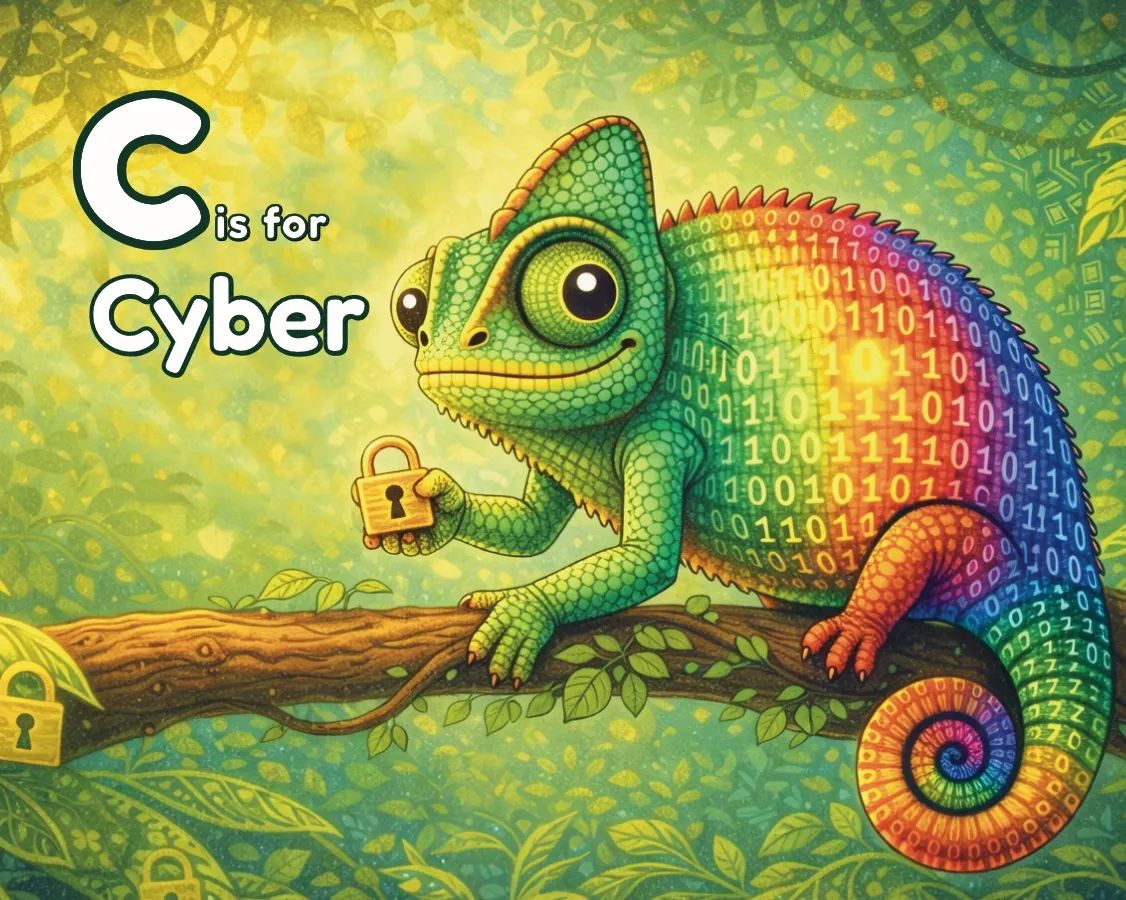
Authentication works like an ant colony — every ant carries a chemical signal that proves it belongs. Encryption works like a chameleon — it transforms what is visible so only the right observer can understand it. A zero-day vulnerability is like a zebra's stripes — something hiding in plain sight that a predator has learned to exploit.
The animal comparisons are not decoration. They are the point. When you understand why something behaves the way it does in nature, the digital equivalent stops feeling abstract.
The book pairs all 26 letters of the alphabet with a cybersecurity concept and the animal that best illustrates it. It is written for families — but the feedback I have had from adults reading it is that it finally made things click that years of news coverage never had.
What this site is for
The book is one piece of it. But cybersecurity does not stand still, and neither can the conversation around it.
Every week there are new incidents, new headlines, and — frustratingly — new ways those headlines misrepresent what actually happened. "AI hacks company" usually means a human gave an automated system too many permissions. "Massive data breach exposes millions" often means a human misconfigured a database setting.
The technology is rarely the villain. The decisions humans make about technology usually are.
This site exists to cover those stories in plain English. No jargon. No scaremongering. No agenda beyond helping families understand the digital world they are already living in.
You will find:
Cyber News — what actually happened, explained calmly and accurately
Cyber Explained — plain English breakdowns of concepts from passwords to ransomware
Cyber Mythbusters — when the headlines get it wrong, we say so and explain why
Good Cyber News — because there is more of it than you would think
Lessons Learned — real incidents, real causes, real takeaways
Every article ends with a section called The Human Factor — a short summary of what technology was involved, what human decision created the risk, and how education could have helped.
Because that is the truth of almost every cyber incident. The technology did what it was told. A human made the decision that led there. And a better-informed human could have made a different one.
Who I am
My name is Robert Shone. I am a writer, an illustrator, and a technology professional with over two decades in the industry.
C is for Cyber is my first book. It took longer than I expected and taught me more than I anticipated — including how much adults need this as much as children do.
I built this site because I believe that cyber literacy is not optional any more. It is a basic life skill, like road safety or financial common sense — and it deserves to be taught the same way: clearly, calmly, and without making people feel stupid for not already knowing it.
I am glad you are here.
— Robert