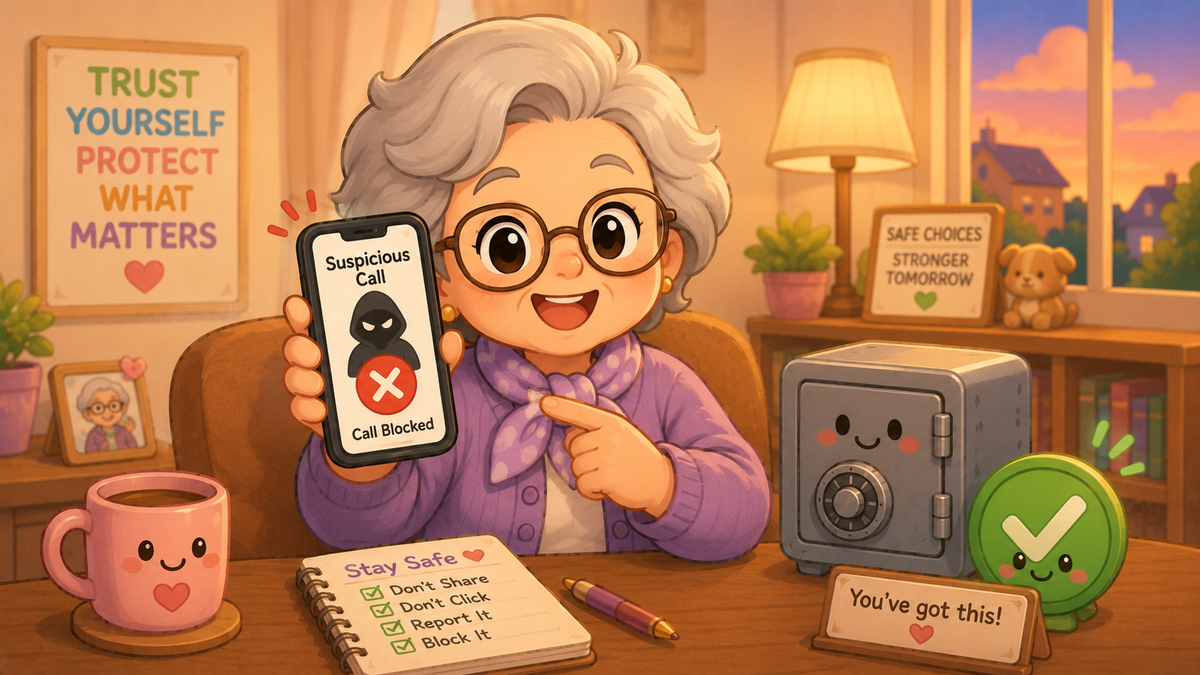
This article is written for older adults, and for the people who care about them. The other parts in this series are written for children, teenagers, and adults. There is no condescension intended here — rather the opposite. This generation has lived through more change than any other and adapted to it more than is often acknowledged.
Let us start with something that does not get said often enough: older adults are not the only people who get scammed, and being targeted does not mean you are naive or foolish. The most experienced professionals in the country get targeted. Bankers, doctors, lawyers, security experts — all of them appear in the fraud statistics. Scammers are professionals who practise their craft every day, targeting the specific vulnerabilities of the specific moment. Understanding that is the first piece of protective knowledge.
The second piece: older adults are disproportionately targeted for specific reasons, and knowing those reasons helps recognise what is happening when it starts.
Why this generation is specifically targeted
This is not about intelligence or experience. It is about circumstances.
People who are retired tend to have more assets than younger people. A lifetime of work, savings, pension funds, property — these are things scammers want access to. The average fraud loss for victims aged 55–74 in the 2025 UK romance fraud statistics was significantly higher than for younger age groups. Investment fraud victims over 60 have in some cases lost everything.
People who live alone, or who have recently lost a partner, may have more time for phone conversations and fewer people to consult before making decisions. Loneliness is not a character flaw. But it is a circumstance that scammers deliberately exploit — romance scams, in particular, invest weeks or months in building a warm relationship specifically because they know it works.
People who grew up trusting institutions — banks, government departments, the police — are more susceptible to authority-based scams because that trust is reasonable and well-earned. When someone presents convincingly as a bank official or a police officer, the instinct to cooperate with them is entirely sensible in almost every real-world context. Scammers weaponise exactly this sensible instinct.
The scams most active against this generation right now
The safe account call. Your phone rings. The caller says they are from your bank's fraud department and have detected suspicious activity on your account. They may already know your name, your sort code, even the last four digits of your card — information available from previous data breaches. They tell you your money needs to be moved to a "safe account" to protect it, or ask you to confirm a one-time code they are sending to your phone.
Neither of these things will ever be asked of you by a genuine bank. No bank will ask you to move your money to a safe account. No bank will ask for the one-time code they just sent you. Hang up. Wait five minutes. Call your bank on the number on the back of your card. The five-minute wait is important — some scammers stay on the line and intercept the callback.
The computer problem call. Someone calls claiming to be from Microsoft, BT, your broadband provider, or a government department, saying there is a problem with your computer or your internet connection. They ask you to download software so they can fix it remotely, or ask you to read out numbers they direct you to.
Neither Microsoft nor BT nor any government department will call you unsolicited about a problem with your computer. They do not monitor individual connections and they do not make these calls. Hang up.
The grandson or family emergency. A call or message, often via WhatsApp, from someone claiming to be a grandchild or other family member in trouble — arrested abroad, had an accident, lost their wallet, needs urgent help. They ask for money to be transferred immediately and beg you not to tell other family members yet.
Call the family member directly on the number you already have before doing anything else. This single step defeats the scam entirely.
Investment offers. Returns that sound significantly better than anything a bank is offering, often involving cryptocurrency, gold, or foreign property. Initial small returns that build trust before larger investments are encouraged. Platforms that show impressive dashboards that are entirely fabricated.
The FCA register at register.fca.org.uk lets you check whether any investment firm is authorised. If it is not on the register, it is not a legitimate UK investment firm. If anyone suggests keeping an investment opportunity secret or acting urgently before an opportunity closes, both of these are warning signs regardless of how legitimate everything else seems.
Technology tips that genuinely help
Two things that make a significant practical difference:
Telephone Preference Service. Register your landline and mobile at tpsonline.org.uk. It does not eliminate all unwanted calls — scammers do not check the list — but it reduces the volume significantly, which makes the genuinely suspicious calls easier to notice.
Call blocking. Many modern phones and broadband providers offer call blocking features. BT CallGuard is free for BT customers. Several standalone devices also exist for landlines specifically. These can be set up to screen calls from unknown numbers, requiring callers to identify themselves before the phone rings. They are particularly effective for older landlines that receive a high volume of cold calls.
The genuinely good news
Fraud reimbursement rules improved significantly in October 2024. If you are tricked into authorising a bank transfer to a scammer, UK banks are now legally required to reimburse you up to £85,000 within five business days, provided you took reasonable care. If you have been the victim of this type of fraud, contact your bank immediately and ask specifically about APP fraud reimbursement.
And: if you or someone you know has been targeted by a scam — even if no money was lost — reporting it helps. Report Fraud at reportfraud.police.uk or 0300 123 2040 (24 hours). Reports that don't result in individual investigations still build the intelligence picture that helps law enforcement disrupt criminal networks.
What does this mean for me?
The safe account call is always a scam. Hang up. Wait. Call your bank directly.
The computer problem call is always a scam. Hang up. Do not download software for anyone who calls you unsolicited.
The family emergency message — call the family member first. One call defeats the whole scam.
Check the FCA register before committing any money to any investment opportunity: register.fca.org.uk.
Register with the TPS if you haven't: tpsonline.org.uk.
Talk about this with family. Not because you need looking after — but because the more openly families talk about scam tactics, the harder scammers find it to operate.
🧠 The Human Factor
| Technology involved | Phone calls, WhatsApp messages, fake investment platforms, and remote access software — all used to exploit trust, authority, and urgency |
| Root cause | Scammers specifically research and target the circumstances of older adults — greater assets, greater trust in institutions, greater likelihood of engaging at length with callers — not because of any personal failing but because these are the characteristics that make this group financially valuable targets |
| What was at risk | Lifetime savings, pension funds, property equity, and the psychological harm — shame, loss of trust, depression — that follows financial fraud |
| Prevention | Hang up on any call asking you to move money or share a security code; call back on a trusted number; check the FCA register; register with TPS; report to Report Fraud |
Useful contacts
- Report Fraud — reportfraud.police.uk or 0300 123 2040
- Stop Scams UK — dial 159 (connects to your bank's fraud team)
- FCA investment register — register.fca.org.uk
- Telephone Preference Service — tpsonline.org.uk
- Age UK — 0800 678 1602 or ageuk.org.uk
- Victim Support — victimsupport.org.uk
- Think Jessica (scam victim support) — thinkjessica.com
This concludes the Cyber Safety for Every Generation series.