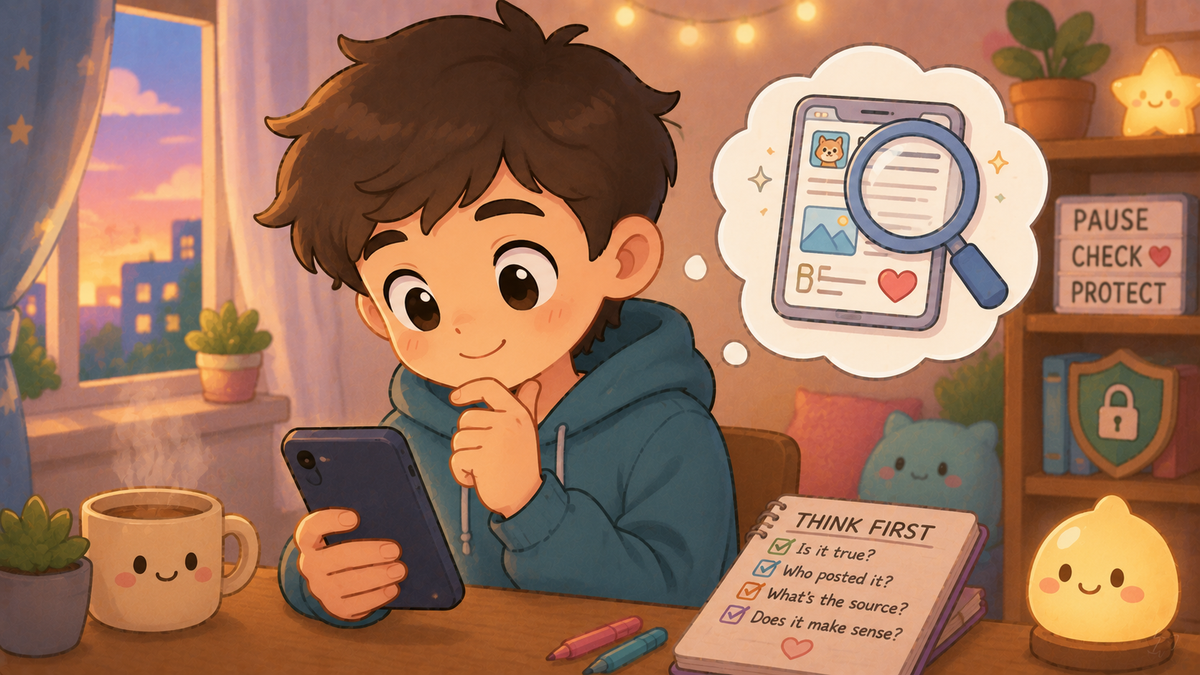
This article is written directly for teenagers. The other parts in this series are written for younger children, adults, and older adults.
Here is something you already know: being a teenager online is complicated in a way that previous generations of teenagers simply did not have to deal with. The social dynamics, the permanence, the audience, the pressure to post, the pressure not to post, the group chats, the people who screenshot, the algorithms that know what keeps you scrolling — none of this existed in the way it does now, and very few adults genuinely understand what navigating it feels like from the inside.
So this article is going to skip the obvious stuff that you have heard fifteen times — don't talk to strangers, don't share your address — and focus on the things that are genuinely tricky, genuinely worth thinking about, and less often talked about honestly.
Your data is being used in ways you cannot fully see
Every platform you use makes money. Most of them make it from advertising. The way advertising works in 2026 is through detailed profiles built from your behaviour — what you look at, how long you look at it, what you like, what you search for, who you interact with.
This is not inherently sinister. But it is worth understanding, because the profile being built about you is real, is detailed, and is used to show you content and advertising designed to keep you on the platform as long as possible. The algorithm does not have your interests at heart. It has engagement metrics as its objective.
Knowing this does not mean you have to stop using the platforms. It means you can use them more deliberately — actively choosing what you seek out rather than passively accepting what gets served to you.
The thing about consent and images
This is the part that most online safety content either glosses over or handles badly, so here it is plainly.
If someone asks you to share intimate images of yourself — of your body — the answer is no. Not "no unless they are your partner." Not "no unless you trust them." No. Full stop.
Under UK law, sharing intimate images of anyone under 18 is illegal, regardless of who took them, who asked for them, or what was agreed. This protects you. But more practically than the law: once an image exists digitally, it can be copied, forwarded, and shared beyond your control in seconds, regardless of any promises made. No relationship guarantee, no "I would never," changes this.
This is not about shame or judgment about teenage relationships. It is about a technical reality — digital images are not private in the way a private conversation is — and a legal one. If you are in a situation where you feel pressured, you can speak to Childline confidentially at any hour.
Passwords and accounts — the boring stuff that actually matters
You have probably been told to use strong passwords many times. Here is the specific reason it matters for you personally.
Accounts get compromised. When your gaming account, your social media account, or your email is taken over by someone else, they can post as you, access your messages, change your passwords so you cannot get back in, and in some cases use your account to scam your contacts.
Two things: use a different password for your email than for everything else, because your email is the master key that unlocks every account that uses "forgot password." And turn on two-factor authentication on your most important accounts — it means that even if someone knows your password, they still cannot get in without your phone.
Group chats and the bystander problem
Group chats have a specific social dynamic that is worth naming. When something unkind or harmful happens in a group chat — a cruel message, someone being piled on, an image shared without consent — there are usually many more people watching than participating. Most of them are uncomfortable. Very few say so.
This is the bystander effect, and it operates powerfully online. Everyone assumes someone else will say something, or fears that speaking up will make them a target. So nothing happens, and the harmful thing continues.
You do not have to be the only person who stands up. But you also do not have to be a silent participant. Leaving a group chat, muting notifications, or privately checking in with the person being targeted are all options that do not require confrontation and do not require you to become a target yourself.
Mental health and the doom scroll
Research on social media and teenage mental health is complex and contested — the headlines are often more definitive than the science. What is consistently found is that passive scrolling — consuming content without interacting — is associated with worse outcomes than active use, where you are creating, connecting, or seeking specific things out.
The difference between going on Instagram to see what your actual friends are doing and going on Instagram to scroll through content served by an algorithm optimised for engagement is significant. One feels like choosing. The other tends to feel like being consumed.
Most phones now have built-in screen time reporting. Looking at your own data — where you are actually spending time, compared to where you intended to spend it — is worth doing once, honestly. Not because there is a correct answer, but because awareness tends to shift behaviour in ways that imposed limits do not.
What to do when something goes wrong
If something goes wrong online — your account is hacked, you have been harassed, something has been shared without your consent, someone has pressured you — the right move is to tell someone. An adult you trust, a friend who will help, or Childline (0800 1111, childline.org.uk, anonymous if you want it to be).
The fear of being judged, or of having technology access restricted, stops many young people from reporting things that they really should report. The answer to that concern is the same one covered in the Digital Family series: adults who care about you want to know, and your phone being confiscated is not an appropriate response to you being the victim of something.
Report the account or content to the platform. Take screenshots before you do. And talk to someone.
🧠 The Human Factor
| Technology involved | Social media algorithms, group messaging platforms, image sharing, account security, and the commercial incentive structures that shape how platforms are designed |
| Root cause | Teenagers navigate online environments that are specifically engineered for engagement, often before they have developed the full capacity to recognise those engineering choices for what they are |
| What was at risk | Privacy, safety, mental health, and the reputational permanence of digital content shared impulsively |
| Prevention | Understanding how platforms work and what they optimise for; strong unique passwords and MFA; knowing that reporting problems to trusted adults is the right response |
Useful resources
- Childline — 0800 1111 or childline.org.uk (anonymous, any time)
- Thinkuknow — thinkuknow.co.uk
- UK Safer Internet Centre — saferinternet.org.uk
- NSPCC — nspcc.org.uk